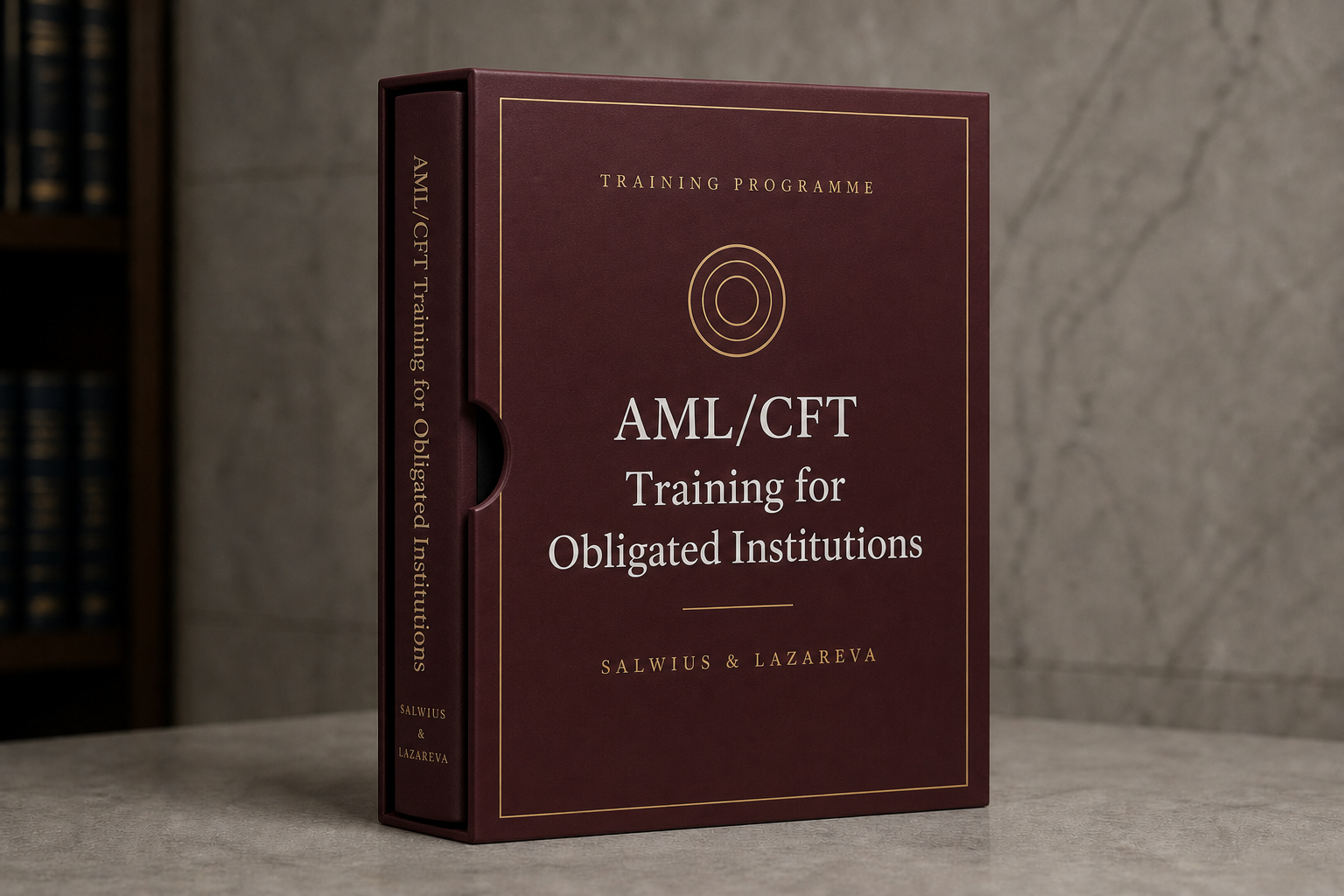
AML/CFT Training for Obligated Institutions
Corporate Training in Counteracting Money Laundering and Terrorist Financing
1999.00zł
The first of it's kind institutional grade, English-language AML/CFT training programme, built for obligated institutions whose compliance function does not operate on assumptions. Inclusive of thirteen modules, 8+ hours of instruction and a final examination.
A concise set of AML/CFT procedure templates included at no charge with every AML Training Programme seat.
The Polish Act on Counteracting Money Laundering and Terrorist Financing places the burden of competence on institutions. Ignorance of the framework is not a mitigating factor in a GIIF inspection and neither is a training record that documents attendance without demonstrating understanding.
This programme is designed for compliance officers who cannot afford the guesswork, management board members who carry personal liability under Art. 299 of the Penal Code, and AMLROs whose name is on filings. This programme covers the statutory framework with the depth that is demanded by the law, the typologies with the specificity practitioners encounter, and the decision-making acumen that distinguishes a defensible programme from a documented one.
The training is delivered live, online or at your premises anywhere within Poland, in group or to even a single trainee without any surcharges. The preference is entirely yours.
Foundations of AML & CFT
The economic logic of laundering. Placement, layering, integration. The gatekeeper problem.
The Polish Regulatory Architecture
GIIF, KNF, KAS, MSWiA. Penalty regime under Art. 147 & 153b. Art. 299 KK personal liability.
Risk-Based Approach
Art. 33(2) five-factor framework. Scoring models. Override documentation. KOR alignment.
Customer Due Diligence
Art. 34 four pillars. CRBR & Art. 61a. Art. 37 Hard Stop. Source of Funds vs Source of Wealth.
Enhanced Due Diligence & PEPs
Art. 44/46 triggers. PEP family members. 12-month transition. Memorandum of Risk Acceptance.
Transaction Monitoring
Documented baselines. Structuring & smurfing. False positive vs false negative asymmetry. KSeF.
Suspicious Activity Reporting
Art. 74 vs Art. 86. Tipping-off prohibition under Art. 54. 24h / 96h / 6-month timelines.
Sanctions & High-Risk Jurisdictions
Three concurrent regimes: EU, OFAC, MSWiA. Ownership & control test. Dual-use goods.
Terrorist & Proliferation Financing
TF as the inverted logic. FATF R.5/6/7. WMD evasion typologies. UN Security Council regimes.
Trade-Based Money Laundering
Over/under-invoicing. Phantom shipments. BMPE. Commodity-code manipulation.
Virtual Assets & New Technology Risk
MiCA & Travel Rule. VASP due diligence. Mixer typologies. Unhosted wallet analysis.
Internal Controls & Governance
Three lines of defence. Art. 8/9/50/52/53. Whistleblower Protection Act 2024.
2026 Regulatory Convergence
AMLA Reg. 2024/1620. KSeF mandatory rollout. AML Package. Travel Rule in force.
Every seat includes the following
11 Internal AML/CFT Compliance Procedure Templates (concise suite)
Verifiable Certificate of Completion with examination score and programme details
AML Glossary: 55 terms with Polish statutory references
Poland AML Act Quick Reference Card (desk reference)
Case Study Workbook: 10 scenarios with decision worksheets
One complimentary final exam retake
Procedure templates (concise version) and reference manual (full version), sold separately at 499 PLN and 699 PLN respectively, are bundled into every training seat.
AML Reporting Officers
Designated AMLROs operating under Art. 9, responsible for the day-to-day AML programme and GIIF liaison.
Board Members
Designated members under Art. 8 carrying management-body accountability for AML compliance.
Legal Advisers
Advocates and radcowie prawni operating as obligated institutions in transactional and advisory roles.
Tax Advisers & Accountants
Doradcy podatkowi and accounting-service providers within the Art. 2(1) obligated-institution perimeter.
Real Estate Professionals
Agents and intermediaries brokering property transactions within the obligated-institution framework.
Notaries
Notaries acting in transactions engaging AML obligations under Art. 2(1)(14) of the 2018 Act.
Payment & Financial Institutions
Banks, payment institutions, investment firms, insurance operators, and credit cooperatives.
Virtual Asset Providers
VASPs and MiCA-licensed CASPs operating under Art. 2(1) and the MiCA transitional framework.
International Teams
Compliance functions in non-Polish-speaking firms responsible for Polish obligated-institution subsidiaries.
Delivery Format
Live delivery: online or at your premises anywhere within Poland. There is no minimum group size for on-premises or online delivery and no surcharges on purchasing a single training seat.
Programme Structure
Thirteen modules across approximately eight hours of instruction, with scheduled breaks. The programme is delivered in a single day.
The Examination
Forty scenario based multiple choice questions (MCQs). Each question presents a realistic Polish obligated institution scenario involving a specific set of facts and a decision to be made. No definitional recall. The passing threshold is 75 per cent (30 of 40 questions). The score is recorded on the Certificate of Completion. Training price includes one additional exam retake in the same sitting.
Certificate of Completion
Issued to every participant who achieves the 75 per cent threshold. The certificate carries a unique reference number linking to the verification page at verify.salwiuslazareva.com. The certificate records the examination score and the programme details.
This programme is provided for educational and informational purposes only. It does not constitute legal, regulatory, financial or compliance advice. Salwius & Lazareva Sp. z o.o. is a business management, strategic consulting and project coordination firm. The operational implementation of information contained herein is the exclusive fiduciary responsibility of your Management Board and designated compliance officers. Our role is limited to delivering regulatory education. While this programme intends to address the topics contemplated by Polish and foreign legislations, your institution's specific compliance posture may require the engagement of its own legal and compliance advisors.
EXPLORE
LEGAL
© 2026 Salwius & Lazareva Sp. z o.o. All rights reserved.